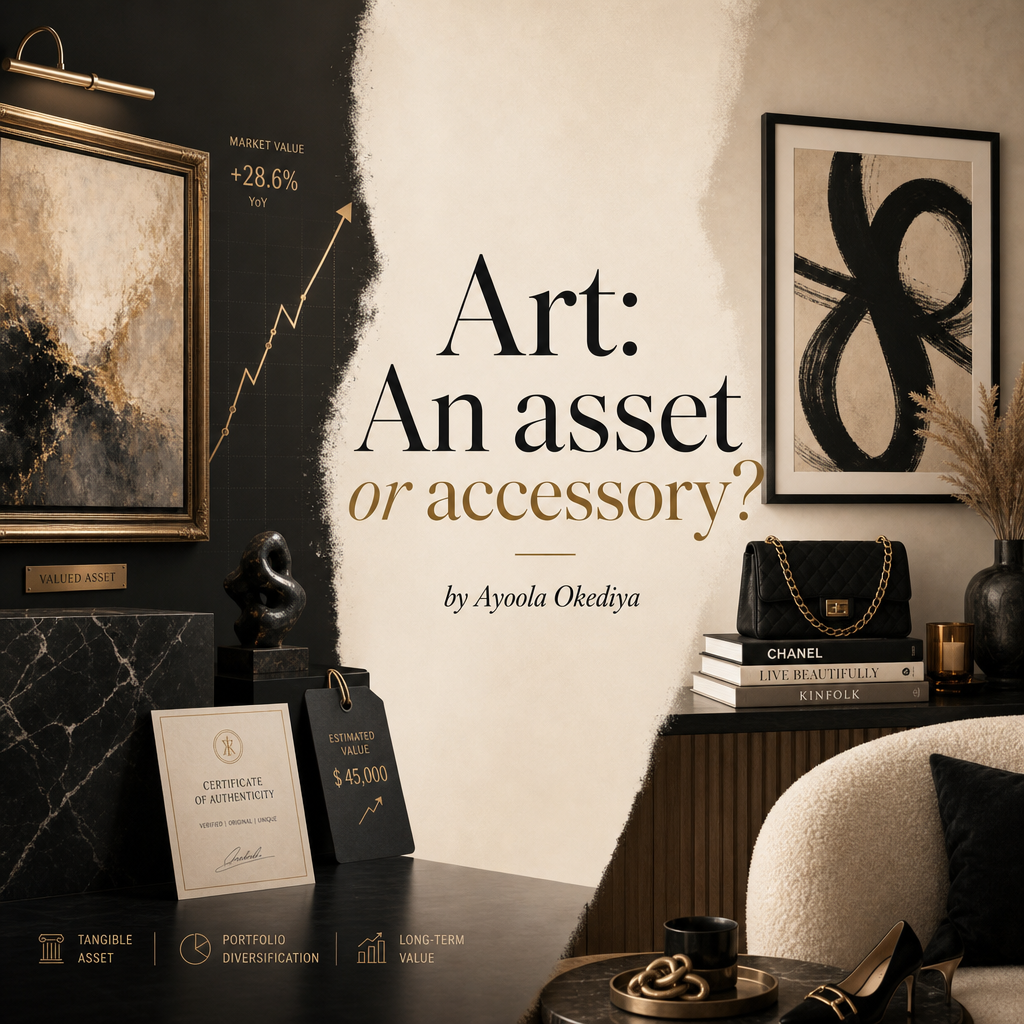
ART: ASSET OR ACCESSORY?
INTRODUCTION
In November 2025, Gustav Klimt’s Portrait of Elisabeth Lederer sold for over
$230 million, becoming the second most expensive work ever sold at auction. To a
sociologist, this was a “Veblen” moment because it is a positional good, a rare item that
confirms the owner's status at the very top of the social and economic hierarchy.
To a wall street Analyst, this is seen as a strategic opportunity. By buying one of the few
remaining private Klimt masterpieces, the investor isn't just buying art; they are securing
a finite, high-demand asset that historically retains its worth even when the broader
economy cools.
In the modern gallery, the Calculator (investor) and the Connoisseur (collector) are
locked in a permanent embrace. One provides the capital; the other provides the soul—
and the status. We call it an 'investment' to soothe our logic, and we call it 'art' to soothe
our vanity.
This shows a thin line between Art as a trophy of ego and wealth fortress.
THE ANATOMY OF A MASTERPIECE
To understand a masterpiece through the eyes of both the Connoisseur and Calculator
is to witness a class between profit and prestige. This tension is the engine of the modern
art market. It pits the quest for a 'guaranteed yield' against the hunger for a 'guaranteed
legacy,' making the artist’s signature both a financial bond and a social gold card.
ART AS AN INVESTMENT
In an era of digital volatility and fluctuating currencies, ‘Physical’ art offers something
increasingly rare: absolute scarcity. Unlike a corporation that can dilute its shares or a
central bank that can print more tender, the supply of a master’s work is historically fixed.
When you invest in a ‘Blue Chip’ artist, you are acquiring a finite resource that exists
outside the traditional banking system—a private, portable, and permanent store of value.
Beyond its scarcity, art functions as a ‘secret shield’ for a diversified portfolio.
Historically, the art market has shown a low correlation with the stock market; when
equities stumble, a masterpiece often holds its ground, driven by a global demand that
remains insulated from interest rate hikes or quarterly earnings reports. It is one of the
few assets that pays a ‘double dividend’: a potential for significant capital appreciation
and a daily return of aesthetic pleasure.
1. The Lindy Effect
This theory suggests that the future life expectancy of a non-perishable thing is
proportional to its current age. A masterpiece has already survived the Ultimate test:
Time. For example, a painting over 100 years has survived wars, economic crashes, and
changes in fashion. Because it has survived that long, it is statistically likely to be relevant
for another 100 years.
To the Investor, this is the ultimate "de-risking" strategy. You aren't betting on a trend;
you are betting on a proven historical survivor. The older and more established the artist's
"market history," the safer the capital.
2. Strategic Capital Silence
Art offers a level of discretion that is almost extinct today. Art is a bearer plant. Whoever
holds the physical object generally controls the wealth it represents. This provides
Geopolitical Mobility.
In times of economic or political instability, moving $100 million in gold is physically
impossible for an individual, and moving $100 million in wire transfers can be a hassle.
A $100 million painting, however, can be shipped in a single crate.
It is a borderless currency that allows for the private transfer of massive wealth across
jurisdictions without the friction of traditional banking.
3. Asymmetric Upside
The Art market is Imperfect and Opaque unlike the stock market which is what an
Investor enjoys. Value in art is often driven by information asymmetry. This allows for
Venture-style returns.
By using deep research to identify undervalued artists or overlooked periods in art
history, an investor can achieve "asymmetric upside"—where the risk is the cost of the
painting, but the potential reward is a 10x return once the rest of the market "discovers"
the artist.
4. Collateralized Utility: Unlocking "Dead" Capital
Skilled investors understand that art, while not yielding traditional income, acts as a store
of value and generates returns through significant long-term capital appreciation.
Financial institutions now offer "Art-Backed Loans."
Essentially, you can keep your $50 million painting on your wall while a bank gives you a
$20 million loan against it.
This allows you to use that cash to buy more property or invest in a new business, all while
your painting continues to grow in value. It is the ultimate financial "win-win": you keep
the masterpiece, but you still get the spending power of the cash.
ART AS ANACCESSORY
The connoisseur knows the truth, at the highest level of society, Wealth is common, but
taste is rare. In this world, a masterpiece is the ultimate accessory—a "Social Passport"
that grants the owner entry into rooms that money alone cannot unlock.
To own a masterpiece is to hold a credential that bypasses the traditional gatekeepers of
power. While a bank statement can prove your solvency, an art collection proves your
sophistication.
To the Collector, Art is not just an investment that hides its monetary value; it is an
identity to be worn in the spotlight. It is the only accessory that doesn't just decorate a
room but validates the soul of the person standing in it.
In the end, the Investor buys a future, but the Collector buys a legacy.
1. Legacy Branding: The Accessory Outlives the Owner
Most goods of Ostentation like cars and Clothing depreciate. While high-end Art accrue
history. Legacy branding is done upon acquisition of a masterpiece; you attach your name
to the artist’s name.
If the piece is loaned to a prominent Gallery, it is addressed as “From the Collection
of”.
The art becomes an accessory to your immortality, ensuring that your name is whispered
in the halls of culture long after your businesses have been sold or forgotten.
2. Positional Dominance
Art is the only good with Absolute Scarcity. For other Luxury commodities there can be
main pieces but for a masterpiece there can only be one.
It represents a monopoly of an experience. When a Connoisseur hosts a private viewing,
they are offering their guests something that cannot be found in a showroom or a boutique.
The value lies in the exclusivity of the gaze—the intoxicating reality that your guests are
standing in front of a masterpiece that exists nowhere else on Earth.
3. Veblen Signal
In Standard markets, demand diminishes as price rises. Art functions as a Veblen Good,
an elite category of luxury where desirability is directly fueled by high cost. For the
Connoisseur, the price is not what they pay for the art; the price is the art.
A masterpiece creates a barrier that effectively filters the merely wealthy. It is a filter that
separates the millionaires from the billionaires, and the billionaires from the truly global
elite.
In the Veblen economy, the price tag isn't a bill—it's a proclamation. It announces that
the owner has moved beyond the world of value and into the world of valuation
THE PROVENANCE
The DNA of Art is called Provenance. It is the history of every hand that has touched
the frame, every vault that has held it, and every museum that has hung it. A painting
without a provenance is Socially invisible.
To the investor, the provenance serves as a legal Audit which transforms the object into
a liquid asset. A “Guarantee of Clean Title” is the prefect provenance for an investor
as it ensures that no third party will emerge years later to claim ownership.
To the Collector, Provenance serves as Lineage. It entails joining an elite group of
prestigious former owners. It shows they are the rightful heir to a traditional taste.
Provenance is where the Wealth and the soul finally agree. The Investor wants the 'Title'
to be safe, and the Collector wants the 'Ancestry' to be noble.
THE PURPOSE
Acquiring a masterpiece isn't the same as buying a House; it's more like adopting a legacy.
The payoff depending on what lens you decide to see this from either from an Investor’s
perspective or from the Collector’s.
The investor’s Dream
For the Investor, the idea of acquiring a masterpiece goes beyond hanging it on a wall; it
is the financial security it poses to his portfolio. It is the ultimate insurance policy against
inflation in event of an economic meltdown.
They take great cognizance in the resale value of their Asset. They look forward to the
moment 10 years from now when the market peaks, and they can sell the piece for a 50%
profit. To the Investor, the "Masterpiece" is a clock that is slowly ticking toward a massive
payday.
The Collector’s Dream.
For the Connoisseur, the excitement starts the moment the painting enters their home.
They aren't looking for an "exit"—they are looking for entry into a higher level of human
history.
They look forward to seeing their name on a museum plaque. For them, the prize is
Legacy; they want to be remembered as a person of great taste, not just a person with a
lot of money.
Owning a rare piece earns them an invite to the most exclusive dinners in Venice, Basel,
and New York. It turns them from a "rich person" into a "Patron of the Arts."
They take pride in the daily physical dividend and emotional high from owning a piece of
the human soul.
THE MASTERPIECE
After the forensic labs have finished their scans, the historians have verified the names on
the crates, and the $200 million has changed hands. We are left with a simple question:
Is art a cold financial asset or a soulful social accessory?
The truth is that art is the only thing on Earth that successfully pretends to be both at the
same time.
The Symmetry of Success
The most successful players in the market are those who can speak both languages. Who
have an in-depth knowledge of trends, quality, originality, taste, negotiation, cost
mechanisms, personal connections.
The Calculator knows that a painting is only a "good investment" if the Connoisseur world
(museums and critics) decides it’s culturally important. If nobody loves art, the price
won't go up.
The Connoisseur knows that they can only afford to be a ‘Patron of the Arts’ if the
Calculator on the side of the market stays strong. If painting isn't a safe store of value, it
becomes an expensive hobby rather than legacy.
The "Winner’s Circle
In the end, the person who "wins" is the one who understands that value is a story we all
agree to believe in. For the Investor, the win is Freedom. They have turned paper money
into a portable fortress that protects their family’s future.
For the Collector, the win is Immortality. They have attached their name to a genius like
Klimt or Rothko, ensuring they will be remembered long after they pass away.
AYOOLA OKEDIYA
Writer and contributor to the Pilgrim Arts journal.